
AI in Supply Chain for Leaders: Build Resilience, Fix Email to ERP

AI can materially shorten recovery time from disruptions and cut operational friction when leaders pair targeted pilots with clean data and governance. The highest-impact areas right now are demand forecasting, automated document processing, and exception triage. None of that works without data readiness and a governance structure like the NIST AI RMF behind it.
TL;DR:
- Effective AI in supply chains depends heavily on data readiness, clean input, and a governance framework like the NIST AI RMF, to prevent delays and failures.
- Priority use cases include demand forecasting, exception detection, and document automation, with ROI quicker for well-structured data environments.
- Challenges such as poor data quality and weak system integration can significantly hinder AI deployment and must be addressed early through validation and human oversight.
- A staged, KPI-focused pilot approach with proper data and governance is essential before scaling to autonomous decision-making systems.
- Vendors like Ampwise AI tackle unstructured document friction, enabling faster, error-reduced data flow into existing ERP systems, crucial for AI success.
Table of Contents
- How AI Works in Supply Chains: Core Capabilities and Data
- Concrete Use Cases With Expected Outcomes and ROI Signals
- What AI Delivers for Resilience, Efficiency, and Sustainability
- Challenges, Risks, and Governance You Cannot Skip
- The Pilot-to-Scale Roadmap for Supply Chain AI
- Agentic AI and Autonomous Orchestration: What Comes Next
- Removing Document Friction: A Practical Enabler
- Ethical Considerations and Bias Mitigation in Supply Chain AI
- Regulatory and Compliance Aspects of AI in Supply Chains
- How AI Adoption Differs Across Industries
- Training Your Team to Work Alongside AI
- What Leadership Should Prioritize Right Now
- Why Ampwise AI Belongs in Your First Pilot
- Sources
- FAQ
How AI Works in Supply Chains: Core Capabilities and Data
AI in supply chain management is not one technology. It is a stack of techniques, each suited to a different problem, and understanding which one does what matters more than chasing the term “AI” as a blanket fix.
Machine learning in supply chain forecasting looks at historical demand, seasonality, and external signals to predict what you will need and when. Optimization algorithms solve constrained problems, like which truck route minimizes fuel and time given traffic and delivery windows. Anomaly detection flags shipments, invoices, or inventory counts that deviate from expected patterns, which is often the first sign of fraud, damage, or a supplier problem. Natural language processing reads unstructured text, including emails, purchase orders, and contracts. Computer vision inspects products and packages on a line or in a warehouse. Agentic AI is the newest layer, capable of taking multi-step actions, like adjusting a purchase order automatically when a supplier confirms a delay, rather than just flagging the issue for a human.
These capabilities only create value when they connect to the systems that already run your operation:
- ERP systems supply the transactional backbone: orders, inventory levels, and financials.
- TMS platforms feed routing, carrier, and shipment status data.
- WMS systems provide real-time warehouse activity, from receiving to picking.
- IoT sensors and telematics add live location and condition data for in-transit goods.
Here is the part most technology vendors underplay. A huge share of supply chain communication never touches a structured system at all. It arrives as a PDF invoice, a scanned packing slip, or a free-text email from a supplier confirming a partial shipment. Enterprise platforms built for AI in supply chain optimization, as IBM describes, depend on clean, structured inputs. When that unstructured layer sits ignored, it becomes the single biggest blocker to getting any AI initiative off the ground.
Concrete Use Cases With Expected Outcomes and ROI Signals
Not every AI in supply chain application deserves equal budget. Some deliver measurable returns within a quarter. Others take longer to pay off but protect against much larger losses. Here is how to prioritize a pilot portfolio by expected outcome.
- Demand forecasting and inventory optimization. Better forecasts mean fewer stockouts and less cash tied up in excess inventory. Companies typically target improved service levels alongside a measurable reduction in working capital, since forecasting accuracy directly reduces the safety stock buffer you need to carry.
- Exception detection and automated triage. AI models flag late shipments, quality mismatches, or documentation errors the moment they appear, instead of days later during a manual audit. The outcome to track is time-to-resolution: how fast an exception moves from flagged to fixed.
- Transport and route optimization. Dynamic routing that accounts for traffic, weather, and delivery windows in real time cuts fuel spend and emissions simultaneously, since fewer miles driven means both lower cost and a smaller carbon footprint.
- Warehouse automation. Robotics and AI-driven slotting increase throughput per labor hour, particularly in high-volume distribution centers where picking paths and storage layout compound small inefficiencies into large ones.
- Predictive maintenance. Sensor data and failure pattern models predict equipment breakdowns before they happen, reducing unplanned downtime on conveyor systems, forklifts, and production lines.
- Document and email automation. Processing purchase orders, invoices, and inquiries that arrive as email or PDF attachments removes one of the most persistent manual bottlenecks between “we received an order” and “the order is in the system.”
Pro Tip: Rank pilots by data availability first, not by potential impact. A high-impact use case with messy source data will stall for months. A modest use case with clean data can go live in weeks and build the internal case for the harder projects.
What AI Delivers for Resilience, Efficiency, and Sustainability
Resilience is the ability to absorb a shock and keep operating, and AI’s clearest contribution here is speed. When a supplier misses a shipment or a port closes unexpectedly, AI-driven scenario planning can model alternative sourcing or routing options in minutes instead of the days a manual replanning cycle usually takes. That compressed recovery window is what separates a minor delay from a customer-facing crisis.
Efficiency gains show up in numbers finance teams already track:
- Lower error rates in order and invoice processing, since automated extraction and validation catch mismatches a tired reviewer might miss.
- Reduced processing costs per transaction, as fewer manual touches mean fewer labor hours per order.
- Improved on-time-in-full (OTIF) delivery rates, driven by better forecasting and tighter routing.
- Faster cash conversion, because inventory optimization frees up capital that was sitting on shelves.
The bigger picture: AI-enabled, machine-readable border and customs procedures are increasingly tied to environmental compliance, not just speed. The OECD’s analysis links standardized, AI-readable trade data to both resilience and sustainability outcomes, suggesting the two goals are converging rather than competing.
Sustainability gains often arrive as a byproduct of optimization, not a separate initiative. Route optimization that reduces mileage reduces emissions in the same calculation. Traceability tools that verify provenance across a manufacturing supply chain, the kind described in NIST’s traceability meta-framework, also support the compliance reporting that regulators and large customers increasingly demand.
Challenges, Risks, and Governance You Cannot Skip
Every AI in supply chain rollout runs into the same handful of failure points, and most of them trace back to data, not algorithms.
Data quality is the most common one. If your ERP has inconsistent SKU naming, duplicate vendor records, or incomplete historical transactions, the AI model inherits those flaws and amplifies them. Integration failures are the second most common: a forecasting tool that cannot talk cleanly to your WMS produces recommendations nobody trusts enough to act on.
Third-party AI risk is a newer and growing concern. When you adopt an AI vendor’s model or platform, that vendor becomes part of your supply chain risk surface. The NIST AI RMF treats this directly, emphasizing human oversight and risk measurement specifically because AI components introduce failure modes that traditional software risk reviews were never built to catch.
Cybersecurity and provenance concerns compound this further. NIST’s cybersecurity supply-chain risk management guidance recommends identifying critical suppliers, setting contractual security requirements, and including those suppliers in incident response planning, a discipline that now needs to extend to your AI vendors as well.
Mitigations that actually hold up in practice:
- Build a validation layer that flags low-confidence AI outputs for human review instead of auto-approving everything.
- Keep a human-in-the-loop for any decision above a defined dollar or risk threshold.
- Maintain a fallback process for when an AI tool goes down or produces clearly wrong results.
- Write contractual SLAs with AI vendors that specify uptime, data handling, and incident notification obligations, mirroring the component-inventory approach NIST recommends for AI supply-chain risk.
The Pilot-to-Scale Roadmap for Supply Chain AI
Rushing straight to full automation is the single most common reason AI in supply chain projects stall out. A staged approach protects both your budget and your team’s trust in the system.
- Pick a pilot tied to one KPI. Choose something measurable and low-friction, like reducing invoice processing time by a defined percentage, rather than a vague goal like “improve efficiency.”
- Get the data in shape first. Canonical mapping between systems, consistent metadata, and a minimal digital twin of your process are the least glamorous parts of the project and consistently the most valuable. Practitioners the World Economic Forum has interviewed describe this prework as the highest-leverage step in the entire rollout.
- Integrate with existing ERP, TMS, and WMS systems. Avoid building a parallel system that runs alongside your ERP instead of inside it, since that duplication is where adoption dies.
- Remove document and email friction early. Unstructured inputs, like scanned invoices or free-text order confirmations, tend to block downstream forecasting and orchestration gains until they are converted into structured data your systems can act on.
- Govern from day one. Apply NIST AI RMF principles: define who signs off on AI-driven decisions, what confidence threshold triggers human review, and how you will audit model outputs over time.
- Set monitoring and retraining cadence. Track time-to-resolution, OTIF, and error rates monthly, and revisit model performance quarterly since demand patterns shift and a stale model degrades quietly.
Pro Tip: Assign one named data owner per system before the pilot starts, not after. Projects that skip this step spend the first month arguing about whose job it is to fix a broken data feed, instead of fixing it.
The World Economic Forum’s research on autonomous supply chains makes a related point worth repeating to any executive pushing for faster autonomy: organizations that prioritize data completeness before deploying advanced AI agents consistently outperform those that skip straight to autonomous decision-making.
Agentic AI and Autonomous Orchestration: What Comes Next
The next phase of AI in supply chain is agentic AI, systems that do not just recommend an action but take it, within defined boundaries. Picture a planner who used to spend mornings firefighting a dozen shipment delays manually. An agentic system now monitors those signals continuously and proposes, or in narrow cases executes, mitigation options, letting the planner focus on judgment calls rather than data gathering.
The World Economic Forum calls this shift autonomous orchestration, where planners move from reacting to individual problems toward overseeing a system that handles routine exceptions on its own. Readiness for this shift depends on three things: how digitized your core systems already are, how well those systems talk to each other, and whether your governance structure can keep pace with faster decision cycles.
Planner roles will not disappear. They will shift toward exception management, strategy, and AI oversight, roles that reward people who understand both the business and the model’s limitations.
Removing Document Friction: A Practical Enabler
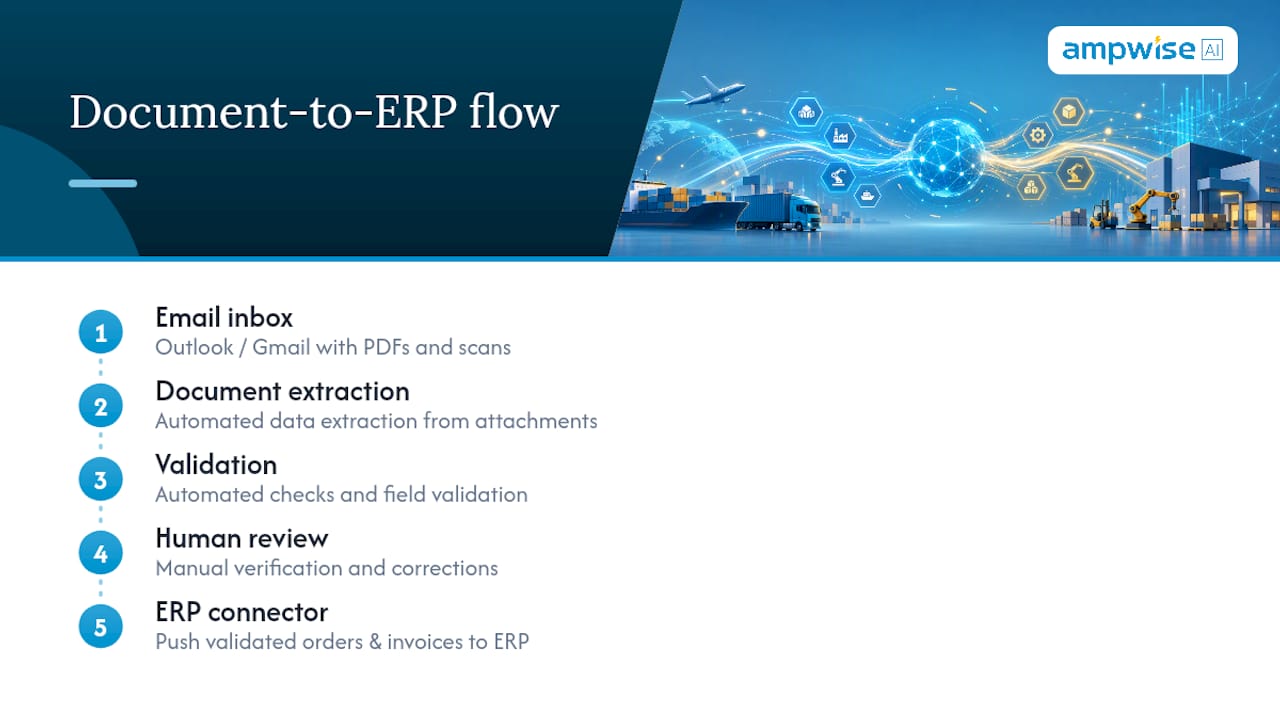
A recurring blocker in supply chain AI pilots is unstructured communication: emails, PDFs, and scanned attachments that never reach the ERP without manual retyping, as explained in AI in Machining: A Pilot-First Guide for CNC Shops. Ampwise AI is built specifically for that gap, automating extraction and validation of orders and invoices from Outlook and Gmail. When evaluating any vendor for this layer, ask about supported document types, ERP connectors, and realistic ROI timelines before committing.
Ethical Considerations and Bias Mitigation in Supply Chain AI
Bias in supply chain AI rarely looks like the headline-grabbing examples from hiring or lending algorithms, but it is just as consequential. A demand forecasting model trained on historical order data will quietly encode past inequities, like consistently underserving a region that was deprioritized during a prior shortage, and keep repeating that pattern unless someone checks for it.
Supplier selection algorithms carry a similar risk. If a model optimizes purely for cost and past performance, it can systematically exclude smaller or newer suppliers who never got the chance to build a track record, narrowing your supplier base in ways that quietly increase concentration risk.
Mitigating this starts with visibility, not perfection. Run periodic audits comparing model recommendations against outcomes across supplier size, region, and category, looking specifically for patterns that disadvantage a group without a clear operational reason. The NIST AI RMF’s emphasis on human centricity applies directly here: a human reviewer should be able to see why a model made a recommendation, not just accept the output.
Transparency with suppliers matters too. If your AI system scores suppliers on reliability or risk, and that score affects contract terms, suppliers deserve to know the criteria. Opaque scoring erodes the kind of trust that a resilient supply chain depends on during an actual disruption, when you need suppliers willing to go the extra mile rather than the bare minimum.
Regulatory and Compliance Aspects of AI in Supply Chains
Regulation around AI in supply chain use is still forming, but the direction is clear enough to plan around now rather than later. Governance frameworks like the NIST AI RMF are voluntary in most jurisdictions today, but they are increasingly the reference standard auditors and large customers ask about, which makes early adoption a competitive advantage rather than a compliance chore.
Trade and customs regulation is moving faster than general AI regulation. The OECD’s work on supply chain resilience points out that machine-readable border procedures and standardized data formats are a growing requirement, particularly for companies moving goods across multiple jurisdictions with different environmental disclosure rules.
Cybersecurity compliance is the most concrete near-term obligation. NIST’s cyber supply-chain risk management guidance already expects companies to document critical supplier relationships and contractual security requirements, an expectation that now extends naturally to AI vendors and the data pipelines feeding your models.
Traceability requirements round out the picture. Industries with strict provenance rules, like pharmaceuticals, food, and defense manufacturing, are watching frameworks like NIST’s manufacturing traceability model closely, since it offers a structured way to prove where a component came from without exposing every detail of a supplier relationship to competitors.
How AI Adoption Differs Across Industries
AI in supply chain optimization does not look the same in a pharmaceutical distribution network as it does in an electronics manufacturer, and the differences matter when you are benchmarking your own progress.
Retail and consumer goods companies lean hardest into demand forecasting and inventory optimization, because their margins live and die on getting the right product to the right shelf before a competitor does. Automotive and industrial manufacturing prioritize predictive maintenance and supplier risk monitoring instead, since a single missing component can halt an entire assembly line for days.
Pharmaceutical and food supply chains put traceability and compliance ahead of cost optimization, given regulatory scrutiny and the real safety stakes of a contamination or counterfeit event slipping through. Logistics and freight companies invest most heavily in route optimization and real-time visibility tools, where fuel costs and delivery windows are the entire business model.
What is consistent across every one of these industries is the order of operations: companies that got measurable results started with a narrow, well-defined pilot tied to a clean data source, then expanded. Companies that tried to automate broadly across a messy data environment from the start report far more stalled projects, regardless of industry.
Training Your Team to Work Alongside AI
The workforce question gets less attention than the technology question, and that is a mistake. An AI forecasting model that planners do not trust or understand will get quietly overridden every time, which erases the ROI you built the business case around.
Start upskilling with the people closest to the data, not the executives furthest from it. Procurement analysts, planners, and warehouse supervisors need to understand what the model is doing well enough to catch a bad recommendation, not become data scientists themselves. A half-day workshop on how the forecasting model weighs recent versus historical data does more for adoption than a slide deck on AI strategy.
Build a feedback loop where frontline staff can flag when an AI recommendation looked wrong, and make sure someone actually reviews those flags. That loop does two things at once: it improves the model over time and it gives your team a reason to trust the system, because their input visibly changes it.
Finally, treat AI literacy as an ongoing program, not a one-time rollout training. Models get updated, new use cases get added, and the skills your team needs six months into a pilot are different from what they needed on day one.
What Leadership Should Prioritize Right Now
Invest in data readiness before you invest in ambitious AI agents, pilot targeted co-pilots that handle exceptions under human oversight, and put governance in place before scale, not after. My honest read of the research is that companies chasing full autonomy skip the boring prework and pay for it in stalled projects. Assign a sponsor, pick one KPI, and secure your data owners this quarter.
— Evert
Why Ampwise AI Belongs in Your First Pilot
Ampwise is the practical fix for the friction that stalls most AI in supply chain pilots before they start: unstructured email and document data that never makes it cleanly into your ERP. Instead of rebuilding your workflow around rigid templates, Ampwise reads free-text emails, PDFs, and scanned attachments the way your team already receives them, then automatically extracts, validates, and enters orders, invoices, and PO confirmations directly into your existing ERP.
That matters because the roadmap in this guide depends on clean, structured data reaching your systems fast, and manual entry is exactly where that breaks down. Ampwise significantly reduces manual data entry, which means fewer errors compounding downstream into your forecasting and orchestration models. Users often see improvements in order processing speed and return on investment within months of adoption. If document friction is what’s been slowing down your AI pilot, see how Ampwise AI works or explore a live product walkthrough to see it against your own email volume.
Sources
The NIST AI RMF anchors AI governance guidance throughout this piece. NIST’s C-SCRM guide supports supplier and cybersecurity risk sections. The NIST traceability meta-framework, OECD’s resilience report, and the World Economic Forum’s orchestration research inform provenance, policy, and agentic AI coverage.
- Autonomous orchestration: the next frontier for supply chain management | World Economic Forum
- Artificial Intelligence Risk Management Framework (AI RMF 1.0) | NIST
- Strengthening supply chains through efficiency, resilience, AI and environmental performance | OECD
FAQ
How Is AI Used in Supply Chain Management?
AI is used for demand forecasting, inventory optimization, route planning, warehouse automation, predictive maintenance, and processing unstructured documents like emails and invoices. Platforms like Ampwise AI extend this by automating the email-to-ERP step that otherwise requires manual data entry.
What Is the Future of Supply Chain With AI?
The near-term future centers on agentic AI and autonomous orchestration, where systems monitor signals and act on routine exceptions instead of just flagging them for review, as the World Economic Forum describes. Readiness depends on data quality, system interoperability, and governance maturity, not just model sophistication.
Will AI Replace Supply Chain Jobs?
AI is more likely to shift supply chain roles toward exception management and strategic oversight than to eliminate them outright. Planners increasingly supervise AI-driven recommendations rather than performing every calculation manually, which raises the value of judgment and domain expertise rather than replacing it.
What Are the Biggest Problems With AI in Supply Chain?
The most common problems are poor data quality, weak integration with ERP or TMS systems, and underestimating third-party AI risk from vendors. The NIST AI RMF recommends treating AI vendors as supply chain components requiring contractual controls and human oversight, not as plug-and-play tools.
How Much Does Ampwise AI Cost?
Ampwise AI’s pricing is available directly on its website rather than published in a fixed rate card. You can review current details and request specifics on the Ampwise AI site.