
Run EDI at the Partner Boundary and Use APIs for Real Time B2B Data

Neither technology wins outright. EDI handles the standardized, contractual documents your partners mandate, like purchase orders and invoices, while APIs handle the real-time events your business actually runs on, like status updates and inventory checks. Most companies moving past 2026 aren’t choosing one; they’re running EDI at the partner boundary and APIs internally, and the sections below cover the security, cost, and migration trade-offs that decision requires.
TL;DR:
- EDI remains essential for contractually mandated, high-volume document exchange, especially in industries like retail and healthcare, despite growing API use.
- APIs provide real-time data transfer suitable for instant updates and visibility, but they increase operational complexity due to inconsistent formats and security responsibilities.
- Hybrid strategies, with translation at the edge, are best to combine EDI for standard documents and APIs for fast, real-time decision-making, reducing delays and errors.
- Implementing a hybrid system involves initial focus on high-cost decision flows, gradual expansion, and integrating unstructured data sources like emails with tools such as Ampwise AI.
- Cost and complexity are driven by partner-based mapping, middleware, and ongoing operations, making careful measurement of decision latency impacts crucial before expanding or replacing existing systems.
Table of Contents
- What Is EDI?
- What Is an API?
- EDI vs API: Where the Real Differences Show Up
- Benefits and Limitations That Actually Affect Your Business
- When Should You Use EDI, APIs, or Both?
- How Do You Architect a Hybrid EDI and API System?
- Security, Standards, and Compliance You Need to Plan For
- What Will Implementation Actually Cost You?
- How Ampwise Fits Into a Hybrid EDI and API Strategy
- The Hybrid Argument Isn’t a Compromise, It’s the Correct Answer
- Sources
- FAQ
What Is EDI?
Electronic Data Interchange is a standardized format for exchanging business documents between companies, built on rules like ANSI X12 (common in North America) and UN/EDIFACT (the international standard). It has been around since the 1970s, and that longevity is exactly why it still runs so much freight, retail, and healthcare traffic today.
EDI moves specific document types through defined channels, and partners agree on the exact structure ahead of time:
- Purchase orders, invoices, and advance ship notices (ASNs) formatted to a fixed schema
- Transmission through Value-Added Networks (VANs), SFTP, or increasingly HTTPS
- Batch windows rather than instant delivery, often running on fixed schedules
- Acknowledgment messages (the classic 997) confirming a document arrived and parsed correctly
That acknowledgment layer is what makes EDI so trusted for audits and disputes. Every transaction leaves a paper trail. The tradeoff is onboarding: each new trading partner typically needs its own mapping work, which is why large enterprises with hundreds of partners still employ dedicated EDI analysts.
What Is an API?
An HTTP-based API lets two systems exchange data on demand, usually as JSON payloads over REST endpoints, instead of waiting for a scheduled batch. Where EDI moves documents, APIs move data points, and they can push that data the instant something changes rather than the next time a file window opens.
Two patterns dominate:
- Request/response: a system asks a question (“what’s the order status?”) and gets an immediate answer.
- Webhooks: the source system pushes an event the moment it happens, like a shipment scan or a payment posting.
Developer experience matters more here than in EDI. Good API documentation and stable versioning determine how fast a partner can actually connect, and a breaking change without warning can knock out an integration overnight. Security and uptime become the API owner’s job rather than a network provider’s. RFC 9205, the IETF’s best-practices guide for HTTP-based APIs, recommends HTTPS by default and flags versioning as a first-class design decision, not an afterthought.
EDI vs API: Where the Real Differences Show Up
The two technologies diverge on five practical dimensions, and most integration mistakes come from ignoring one of them.
- Timing: EDI typically runs in batch windows, sometimes hourly, sometimes overnight. APIs, especially with webhooks, deliver in near real time.
- Data model: EDI uses rigid, standardized document formats (X12 850, EDIFACT ORDERS) that every partner reads identically. APIs use flexible JSON or XML payloads that vary by provider, which is powerful but means no two partners’ APIs look quite the same.
- Partner constraints: Large retailers, healthcare payers, and logistics networks often mandate EDI contractually. APIs are usually optional unless a specific partner offers nothing else.
- Error handling and audit trail: EDI’s 997 acknowledgment creates a built-in, timestamped record that holds up in a billing dispute. APIs return an HTTP status code instantly, but building an equivalent audit trail is the integrator’s responsibility, not the protocol’s.
- Scalability and ownership: EDI scales through the VAN or gateway provider, who owns much of the security burden. APIs scale (or break) based on how well your own team designed rate limits, retries, and failover.
Adoption gap: Global trade digitalization implementation reached about 71% in 2025, but cross-border paperless trade implementation lagged at just 49% in the same period. That gap between “digitized on paper” and “actually exchanging data electronically across borders” is a big part of why EDI hasn’t gone anywhere, even as API adoption climbs.
Industry integration specialists at TIBCO frame the two as complementary rather than competing: EDI as the backbone for high-volume, standardized transactions, APIs for the real-time flexibility that backbone was never built to deliver.
Benefits and Limitations That Actually Affect Your Business
The technical differences matter only because they translate into cost, risk, and customer experience.
- EDI’s strength is dispute resilience. When a retailer claims an invoice never arrived, the 997 acknowledgment and standardized format settle the argument fast. Its weakness is onboarding cost: mapping a new partner can take weeks and specialized labor.
- EDI also wins on regulatory acceptance. Customs authorities and large payers often require it outright, which removes the “should we?” question entirely, but it comes with latency. A batch that runs every four hours means a shipment status is never truly current.
- API’s strength is visibility. Real-time tracking, rate-shopping across carriers, instant credit checks. All of these depend on data that’s fresh to the second, something batch EDI can’t deliver.
- API’s weakness is inconsistency and ops load. Every partner’s API looks different, so you’re building custom adapters instead of one universal map, and your team now owns security patching and uptime monitoring that a VAN used to handle.
An invoicing dispute favors EDI’s paper trail. A live shipment tracker favors an API’s immediacy. Most companies need both running at once, for different jobs.
When Should You Use EDI, APIs, or Both?
Three questions cut through most of the confusion: Does a partner mandate a format? Does the document need contractual, auditable proof? Does the business lose money the longer a decision waits?
That maps to three common patterns:
- EDI-only: contractual, high-volume flows where a partner (a major retailer, a customs authority) requires it and there’s no negotiating.
- API-first: partner-optional flows where speed matters more than standardization, like live inventory checks or dynamic pricing.
- Hybrid: EDI stays at the partner boundary for mandated documents, while APIs and internal events handle everything downstream that needs to move faster than a batch window allows.
Sequencing matters more than most roadmaps admit. Prioritize APIs for flows where decision latency actually costs money, tracking, capacity checks, exception alerts, and leave contractual documents like customs filings and invoicing on EDI until there’s a clear reason to move them. Locus’s integration guidance for logistics teams makes the same case: modernize where speed changes outcomes first.
Pro Tip: Before building anything, measure how much a delayed decision actually costs, in dollars or hours lost, for each data flow. That number tells you which integration to fund first far better than a generic “APIs are modern” instinct does.
How Do You Architect a Hybrid EDI and API System?
The safest pattern is translation at the edge, not replacement. Inbound EDI documents get converted into internal events the moment they arrive, which then drive real-time decisioning inside your systems. Outbound EDI gets rendered from that same internal event state when a partner requires it. Neither side ever has to wait on the other’s cadence.
A few structural choices make this work in practice:
- API façades and canonical data models sit between wildly different partner formats and your internal systems, so your core logic never has to know whether the source was an X12 850 or a REST webhook.
- Middleware does the heavy lifting: iPaaS platforms, dedicated B2B gateways, and mapping engines all handle translation, though the right choice depends on partner count and document complexity.
- Event-driven internals mean your warehouse, finance, and customer-facing systems all react to the same event stream instead of polling files on a schedule.
Watch for the anti-pattern that undoes all of this: building an “API” that just polls a file drop every fifteen minutes. That’s EDI’s batch behavior wearing an API’s clothing, and it delivers none of the real-time benefit you built it for.
Security, Standards, and Compliance You Need to Plan For
EDI’s security model is largely delegated. VANs and B2B gateways handle transport encryption and network security, so a company’s internal team inherits relatively little operational burden. APIs flip that: your team owns HTTPS enforcement, token management, and credential rotation directly.
A few non-negotiables show up across the standards bodies:
- RFC 9205 recommends HTTPS for every authenticated API endpoint, covering authentication, integrity, and confidentiality in one layer.
- An IETF draft on authenticated HTTP API guidance warns against ever accepting credentials over an unencrypted channel and recommends HSTS to prevent downgrade attacks.
- Cross-border flows carry extra weight: global paperless trade implementation sits at just 49% even as broader digitalization reached 71% in 2025, which means regulatory archival requirements often still assume EDI-style document trails.
Auditability isn’t optional in regulated industries, so whichever protocol you pick, plan the retention and retrieval story before go-live, not after an audit request lands.
What Will Implementation Actually Cost You?
Budget conversations go sideways when they treat EDI and API projects as the same line item. They’re not.
The real cost drivers are mapping and middleware licensing, partner-by-partner testing cycles, ongoing security operations (heavier for APIs), and developer hours for both initial build and long-term maintenance.
A realistic rollout looks like this:
- Pick a pilot flow where decision latency costs real money, like shipment tracking or capacity alerts, rather than starting with your most complex contractual document.
- Build the translation layer (EDI-to-event or API façade) around that single flow first.
- Run it in parallel with the existing process for one full billing or reporting cycle to catch discrepancies.
- Track manual exceptions, order-to-cash time, and dispute volume as your success metrics.
- Expand to the next highest-latency-cost flow only after the pilot shows measurable ROI, typically within a couple of quarters.
How Ampwise Fits Into a Hybrid EDI and API Strategy
A lot of B2B data never touches EDI or a clean API at all. It arrives as a free-text email, a PDF attachment, or a scanned purchase order sitting in someone’s inbox, and that’s where most manual data entry still happens.
Ampwise AI is built specifically for that gap. It reads orders, inquiries, invoices, and PO confirmations directly out of Outlook or Gmail, no templates required, and extracts the data whether it arrives as a PDF, a scanned document, or plain text. Ampwise’s own claims put manual data entry reduction at up to 90%, with clients seeing ROI within three months of deployment.
In architecture terms, Ampwise slots in as a pre-processing layer: it turns unstructured email traffic into the same clean, structured events your API layer or EDI renderer already expects, extending hybrid integration to the messiest data source most companies never planned for.
- Handles PDFs, scanned documents, and free-text emails without partner-side changes
- Integrates with existing ERP systems without retraining staff
- Feeds structured data into whichever downstream flow, EDI or API, actually needs it
The Hybrid Argument Isn’t a Compromise, It’s the Correct Answer
Most articles on this topic frame EDI as legacy and APIs as the future, then hedge with “but you might still need EDI for a while.” That framing gets the emphasis backwards. EDI isn’t a holdover, it’s the correct tool for exactly the job it does: standardized, auditable, contractually mandated exchange. Treating it as a migration target you’re working your way out of leads teams to underinvest in the EDI processes still carrying their highest-volume, highest-risk transactions.
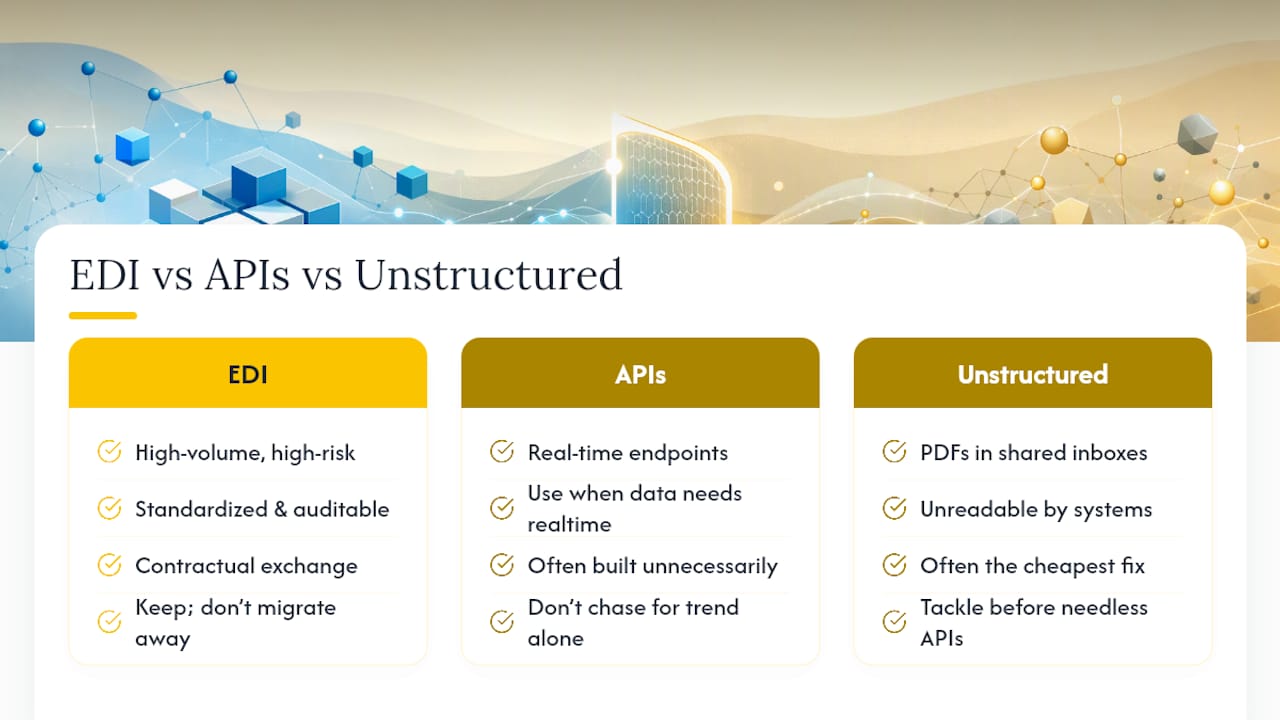
The bigger mistake I see is companies chasing API modernization for its own sake, building real-time endpoints for data nobody needs in real time, while the actual bottleneck sits somewhere unglamorous: a shared inbox full of PDFs no system reads automatically. That’s not an EDI problem or an API problem. It’s an unstructured-data problem, and it’s often the cheapest one to fix first.
Prioritize by decision latency cost, not by which protocol feels more current. A four-hour batch delay on a customs document rarely costs you anything. A four-hour delay on a capacity check might cost you a customer.
— Evert
Sources
For the underlying data and specs referenced throughout this piece, a few sources are worth bookmarking directly:
- UNCTAD — Launch of the Trade Digitalization Index
- Locus — EDI vs API in Logistics: Integration Decision Guide
FAQ
Is API Replacing EDI?
No. APIs are growing fast for real-time flows, but EDI still handles the standardized, contractual documents that trading partners and regulators mandate. Most enterprises run both, with EDI at the partner boundary and APIs driving internal decisioning.
What Has Replaced EDI?
Nothing has fully replaced EDI. APIs have supplemented it for real-time use cases like tracking and inventory checks, but the standardized document exchange EDI handles, invoices, purchase orders, ASNs, still runs largely unchanged in industries like retail, healthcare, and logistics.
Is EDI Still in Use?
Yes, extensively. Large retailers, healthcare payers, and customs authorities frequently mandate it contractually, and the gap between overall trade digitalization (71%) and cross-border paperless trade (49%) shows how much operational exchange still relies on established formats like EDI rather than newer API-based alternatives.
Should a Small Business Choose EDI or an API First?
It depends on what your partners require. If a major retail or logistics partner mandates EDI, you have no choice but to build it; if your integrations are optional and speed matters more, an API-first approach usually costs less to start and iterate on.
How Do EDI and API Handle Errors Differently?
EDI uses acknowledgment messages like the 997 to confirm a document arrived and parsed correctly, creating an audit trail useful in disputes. APIs return an HTTP status code immediately, but building an equivalent, timestamped audit record is left to the integrating team.